
Best Red Light Sleep Devices 2026 — An Honest Comparison
Updated May 2026 · 6-minute read
If you've searched "best red light therapy device for sleep" recently, you've probably found a confusing mix of full-body panels designed for skin and muscle recovery, tiny bedside lamps marketed for relaxation, and a handful of premium devices that combine light with sound or frequency. They are not the same product, and most are not optimized for sleep.
This guide compares the five most-mentioned red light devices for sleep in 2026 — Helight Sleep, Joovv Mini 3.0, Hooga HG300, PlatinumLED Mini, and CalmiPulse — on the specs that actually matter for falling asleep: wavelength, eye-safe brightness, bedside form factor, sleep protocol, and price-per-night-of-use.
We make the device sold on this site (CalmiPulse), so we'll be transparent about where competitors win and where we believe our design has an edge. Use the table, then read the deeper notes to decide which one fits your bedroom.
TL;DR — The Comparison Table
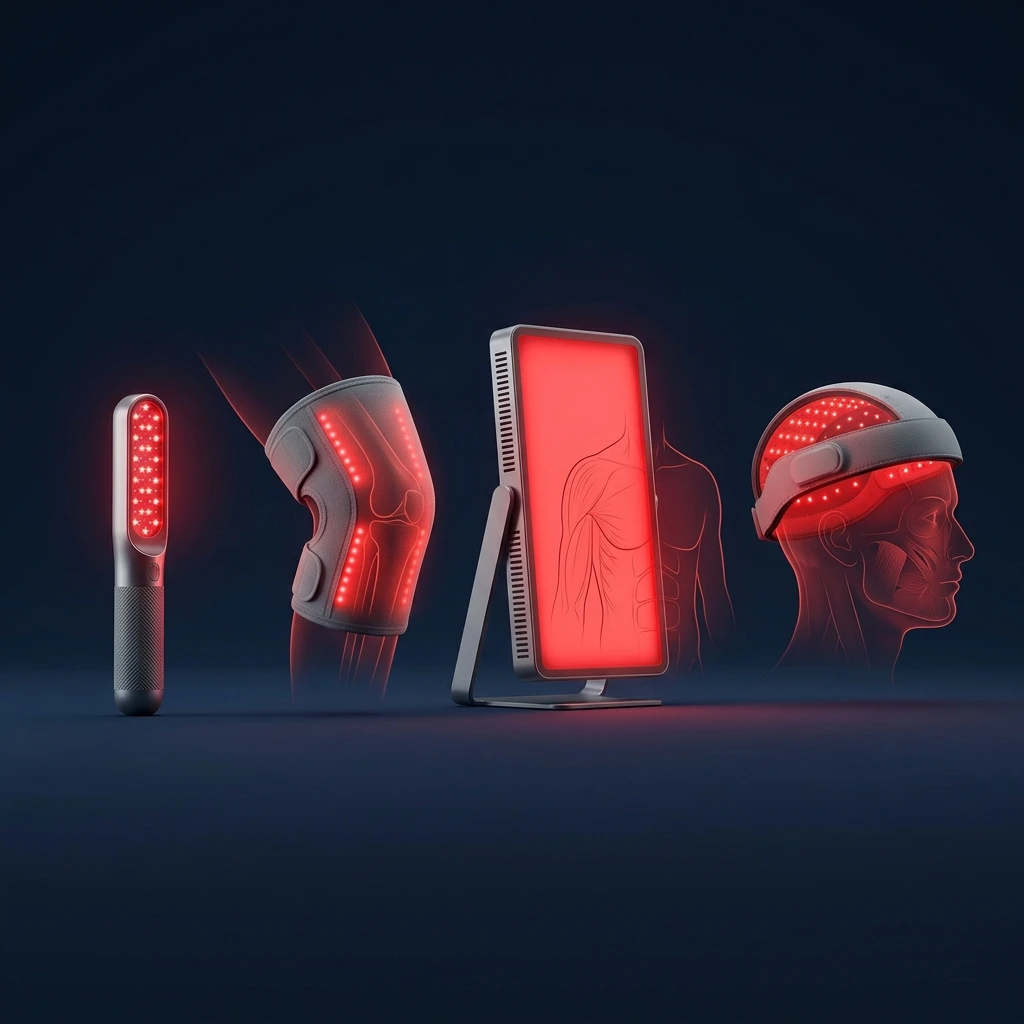
| Device | Wavelength | Built-in Sleep Protocol | Frequency Modulation | Bedside Size | Price (USD) | Best For |
|---|---|---|---|---|---|---|
| CalmiPulse | 670 nm | Yes (20-min wind-down) | 7.83 Hz Schumann | Compact bedside | $199 (sale, $499 MSRP) | Sleep + nervous system regulation |
| Helight Sleep | 630 nm | Yes (28-min protocol) | No | Compact bedside | ~$139 | Pure sleep onset, lowest price |
| Joovv Mini 3.0 | 660 nm + 850 nm NIR | No (manual timer) | No | Wall/stand panel | ~$1,099 | Skin & muscle recovery, not sleep-specific |
| Hooga HG300 | 660 nm + 850 nm NIR | No (manual timer) | No | Wall/stand panel | ~$249 | Budget panel, broad therapy use |
| PlatinumLED Mini | 660 nm + 850 nm NIR | No (manual timer) | No | Hand-held / panel | ~$249 | General red light therapy |
Prices reflect publicly listed brand-site and Amazon prices as of May 2026 and may change.
Key takeaway: If your goal is better sleep, only two devices on this list are built end-to-end for the bedroom — Helight Sleep and CalmiPulse. The Joovv, Hooga, and PlatinumLED panels are excellent recovery tools, but they are designed for skin and tissue, not for falling asleep.
What Actually Matters for a "Sleep" Red Light Device
Before we go device by device, here are the four things that separate a sleep device from a generic therapy panel.
1. Wavelength — 630 nm to 670 nm is the relevant band
The 600–700 nm "deep red" range is what published research uses when studying sleep, mood, and circadian timing. Crucially, several studies confirm that red light in this range, delivered through closed eyelids at low intensity, does not suppress melatonin the way blue light does — making it safe to use at night.[¹·²]
Devices that pair red light with 850 nm near-infrared (NIR) — Joovv, Hooga, PlatinumLED — are leveraging NIR for deeper-tissue mitochondrial effects (skin, muscle, joints). NIR is not the sleep-relevant wavelength.
2. Eye-safe intensity, not panel power
A 100 W therapy panel is too bright for the bedroom — most users have to keep their eyes shut and face away, which defeats the relaxation purpose. A purpose-built sleep device dims to an intensity that's comfortable to be passively bathed in, not a treatment dose.
3. A protocol, not a timer
Helight pioneered the idea of a structured wind-down: the light fades on a curve over 28 minutes, then turns off. CalmiPulse uses a 20-minute curve. Generic panels just run at full power until you hit the off button — that's not a protocol.
4. Frequency modulation (optional but emerging)
This is the newest dimension. The CalmiPulse modulates its 670 nm output at 7.83 Hz — the Schumann resonance frequency that broadly aligns with the human brain's theta-alpha boundary. Our internal hypothesis is that combining a sleep-friendly wavelength with a parasympathetic-friendly frequency provides a fuller wind-down cue than light alone. The published literature on combined light + frequency for sleep is still early-stage; we'll discuss honest caveats below.
Device-by-Device Notes
CalmiPulse — $199 (sale)
- - Wavelength: 670 nm
- - Frequency: 7.83 Hz Schumann modulation
- - Protocol: 20-minute fade-down
- - Form: Compact bedside unit, eye-safe brightness
- - Why we built it: The two leading paths — pure sleep light (Helight) and pure therapy panel (Joovv/Hooga) — each leave a gap. Helight is single-wavelength and single-purpose; the panels are too bright and not designed for bed. We wanted a bedside device that combines a sleep-relevant wavelength and a nervous-system-relevant rhythm.
- - Honest caveat: The combined-modality claim is supported by separate bodies of research on red light and on low-frequency electromagnetic exposure; we have not yet published a peer-reviewed RCT specifically on the Core. We're transparent about this.
→ See full CalmiPulse specs and 60-night trial
Helight Sleep — ~$139
The most widely reviewed pure sleep device, used on the International Space Station. 630 nm pure red light with a patented 28-minute protocol.
- - Strengths: Simple, well-priced, focused.
- - Limitations: No frequency component, slightly shorter wavelength (630 nm vs. 670 nm peak absorption), no ambient design — it's a small puck.
Joovv Mini 3.0 — ~$1,099
A premium clinical-grade panel. Best-in-class for skin, muscle, and recovery thanks to high-power 660/850 nm output.
- - Strengths: Build quality, irradiance, NIR for deeper tissue.
- - Limitations: Not a sleep device — too bright for bedside, no sleep protocol, requires you to stand in front of it.
Hooga HG300 — ~$249
The budget-friendly recovery panel. Dual 660 nm / 850 nm.
- - Strengths: Affordable entry to red light therapy.
- - Limitations: Same as Joovv — therapy-panel form factor, not engineered for the bedroom.
PlatinumLED Mini — ~$249
Comparable to Hooga in spec and use case. Dual 660 nm + 850 nm, hand-held to small panel form.
- - Strengths: Good wavelength mix for general therapy.
- - Limitations: Same category — not sleep-protocol designed.
Pick the Right Device for Your Goal
| If you want to… | Pick |
|---|---|
| Fall asleep faster, simplest possible setup | Helight Sleep ($139) |
| Fall asleep faster with nervous-system support | CalmiPulse ($199) |
| Speed up post-workout muscle recovery | Joovv Mini 3.0 ($1,099) |
| Try red light therapy for skin on a budget | Hooga HG300 ($249) |
| Mix recovery and skin use, mid-budget | PlatinumLED Mini ($249) |
Honest Caveats
We want every reader to make an informed decision, so here are the limits of current evidence:
- Red light + sleep research is real but still small. The strongest support comes from studies on athletes (Zhao et al., 2012)[¹] and sleep-inertia mitigation (Figueiro et al., 2019)[³]. Larger RCTs across general populations are still needed.
- No red light device is a cure for clinical insomnia. If you have persistent sleep issues, see a sleep physician. These devices are wellness tools, not medical treatments.
- The combined light + frequency approach (CalmiPulse) is hypothesis-driven based on parallel literatures. We don't claim a peer-reviewed RCT on the combined product yet. We do guarantee a 60-night trial so you can test it yourself.
- Helight, Joovv, Hooga, and PlatinumLED are all legitimate products within their intended categories. This comparison is about matching the right tool to the right goal, not about declaring a winner across all use cases.
References
- Zhao J., et al. Red light and the sleep quality and endurance performance of Chinese female basketball players. Journal of Athletic Training, 2012. PMC3499892
- Sletten T.L., et al. Effects of red light on sleep and mood in healthy subjects and individuals with depression. Frontiers in Psychology, 2023. PMC10484593
- Figueiro M.G., et al. Effects of red light on sleep inertia. Nature and Science of Sleep, 2019. PMC6506010
- Figueiro M.G., et al. Red light: A novel, non-pharmacological intervention to promote alertness in shift workers. Journal of Circadian Rhythms, 2021. PMC8059068
CalmiPulse manufactures one of the devices reviewed in this comparison. We've written this guide to help you choose the right tool for your goal — even when that means another brand. If you decide CalmiPulse fits your needs, our 60-night sleep trial lets you test it risk-free.