
Mitochondrial Optimization: How 670nm Red Light Resets the Sleep-Wake Cycle
Reading time: 9 minutes · Last updated: May 29, 2026
When we talk about sleep, we often focus on the brain—melatonin, cortisol, and circadian rhythms. However, recent scientific breakthroughs from 2025 and 2026 have shifted the focus to a much smaller scale: the mitochondria. These "powerhouses of the cell" do more than just generate energy; they are the primary gatekeepers of our biological clock.
By utilizing specific wavelengths of light, specifically 670nm deep red light, we can directly influence mitochondrial efficiency to combat insomnia and reset the sleep-wake cycle at a cellular level.
The Cellular Battery of Sleep
Every cell in your body depends on Adenosine Triphosphate (ATP) to function. Sleep itself is an energy-intensive process—your brain uses sleep to flush out neurotoxins and repair tissues. If your mitochondria are inefficient, your body lacks the "fuel" needed to transition into deep, restorative sleep.
Research published in early 2026 suggests that mitochondrial dysfunction is a primary driver of chronic insomnia. When mitochondria are stressed, they produce excessive Reactive Oxygen Species (ROS), leading to cellular inflammation that keeps the nervous system in a state of high alert.
Why 670nm? The Science of Photobiomodulation
Not all red light is created equal. The 670nm wavelength is considered a "sweet spot" in photobiomodulation (PBM) for two critical reasons:
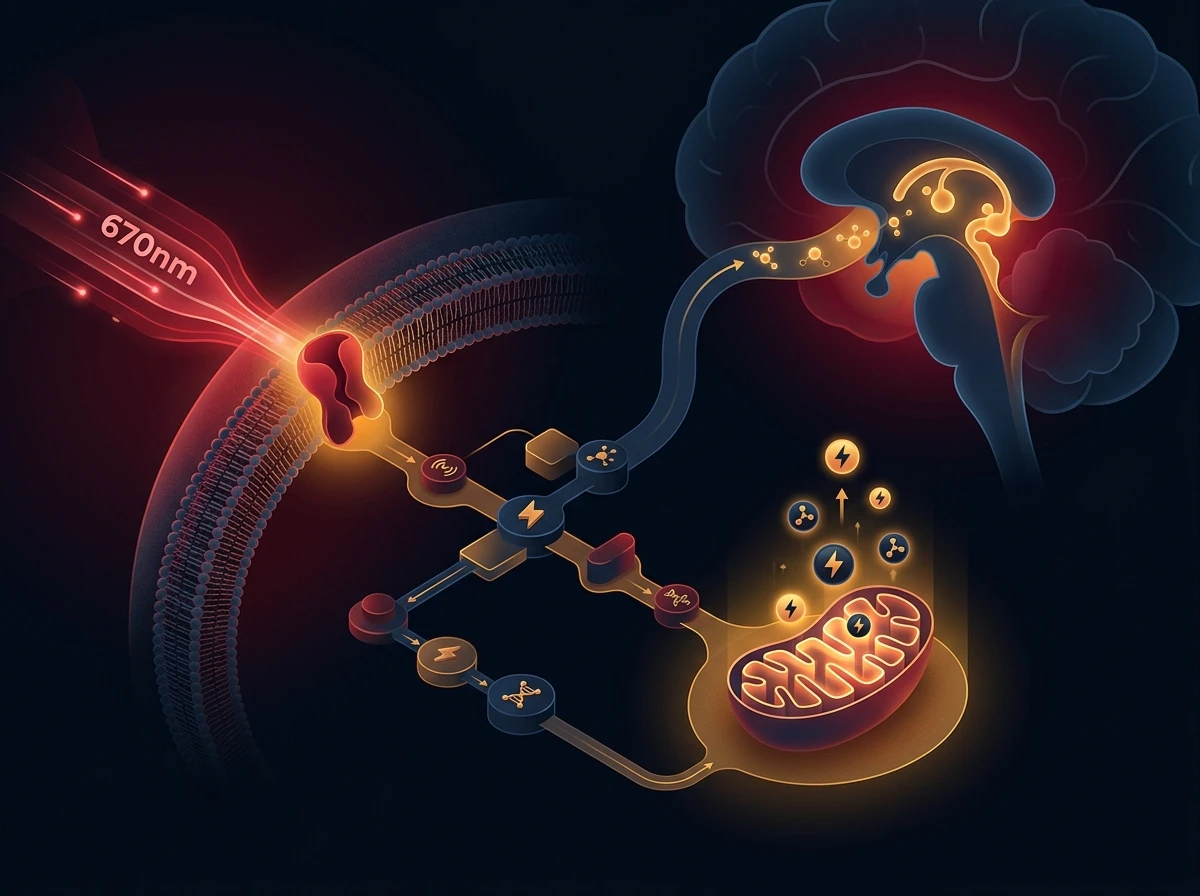
- Cytochrome c Oxidase Absorption: This is the primary enzyme in the mitochondria responsible for ATP production. It has a high absorption peak around 670nm. When photons of this wavelength hit the enzyme, they kickstart the electron transport chain, increasing ATP production by as much as 150-200%.
- Water Viscosity Reduction: At 670nm, red light reduces the viscosity of the interfacial water layers within the mitochondria. This allows the ATP synthase "motor" to spin faster and more efficiently, essentially supercharging the cell's battery.
ATP Production and Melatonin Synthesis
The most significant link between mitochondria and sleep is the synthesis of melatonin. While most people know melatonin as a hormone produced by the pineal gland, recent studies have confirmed that extra-pineal melatonin is also synthesized within the mitochondria of almost every cell.
By boosting ATP production via 670nm light, we provide the necessary energy for the enzymes (specifically SNAT and ASMT) that convert serotonin into melatonin. This means that red light therapy doesn't just "signal" sleep; it provides the raw cellular energy required to produce the sleep hormone.
| Traditional Sleep Aids | 670nm Mitochondrial Therapy |
| :--- | :--- |
| Chemical sedation | Cellular energy optimization |
| External supplementation | Stimulates internal production |
| Morning grogginess, dependency | None (non-invasive) |
| May suppress natural production | Improves baseline mitochondrial health |
Clinical Evidence: 2025-2026 Highlights
- The "Nurse Study" (2025): A clinical trial (NCT05146596) involving night-shift nurses found that 20 minutes of 670nm light exposure post-shift reduced time-to-sleep by 34% and significantly lowered cortisol spikes.
- Glucose and Sleep (May 2025): Research showed that improving mitochondrial efficiency with red light therapy reduced blood glucose spikes by 27.7%, which stabilized energy levels and prevented nighttime wakings.
The CalmiPulse Core Protocol
To achieve mitochondrial optimization for better sleep, consistency and timing are key. The CalmiPulse™ Core is specifically engineered to deliver the precise 670nm wavelength required for this biological response.
Evening Wind-Down (1-2 hours before bed)
- Distance: 12-18 inches from the face/chest.
- Duration: 15-20 minutes.
- Effect: Stimulates Cytochrome c Oxidase to begin the ATP-to-Melatonin conversion process.
Sleep Maintenance (Throughout the night)
- Setting: Nightstand mode (7.83Hz Schumann Resonance only).
- Effect: While the light is off, the Schumann frequency provides a grounding signal to maintain a low-stress state for the autonomic nervous system.
Honest Caveats and Safety
While 670nm red light is exceptionally safe, it is not a "magic pill."
- Consistency: Mitochondrial health takes time to rebuild. Most users report significant changes after 7-14 days of consistent use.
- Dosage: More is not always better. Over-exposure can lead to a "diminishing returns" effect known as the biphasic dose-response. Stick to the recommended 15-20 minute sessions.
- Light Sensitivity: If you have a history of retinal issues, consult a professional before direct eye exposure, though the CalmiPulse Core is designed for ambient, non-laser use.
References
- News-Medical, "Can Red Light Therapy Improve Sleep, Skin, and Recovery?", March 28, 2025.
- Optimal Health Resources, "Complete Guide to Red Light Therapy & Photobiomodulation", November 18, 2025.
- Sleep Med Res, "Photobiomodulation and Its Therapeutic Potential in Sleep Disorders", 2024.
- Genetic Lifehacks, "Red Light and Photobiomodulation: ATP from Photons", May 23, 2025.
- Eudemonia, "The Red Light Therapy Issue: Deep Dive into Mitochondrial Health", January 30, 2026.
---
Optimize Your Mitochondria Today
The secret to deep sleep isn't in a pill; it's in your cells. Experience the mitochondrial-reset power of 670nm light with the CalmiPulse™ Core.