
Reading time: 8 minutes · Last updated: May 2026
Anxiety disorders affect over 40 million U.S. adults (NIMH, 2023). Most pharmacological treatments come with side effects, dependency risk, or weeks-long onset times. Non-pharmacological alternatives — including light-based interventions — have grown rapidly in published research over the past decade. Here we summarize 5 peer-reviewed studies on red light therapy for anxiety, with an honest read on what the evidence actually supports.
Why Red Light & Anxiety? The Mechanism
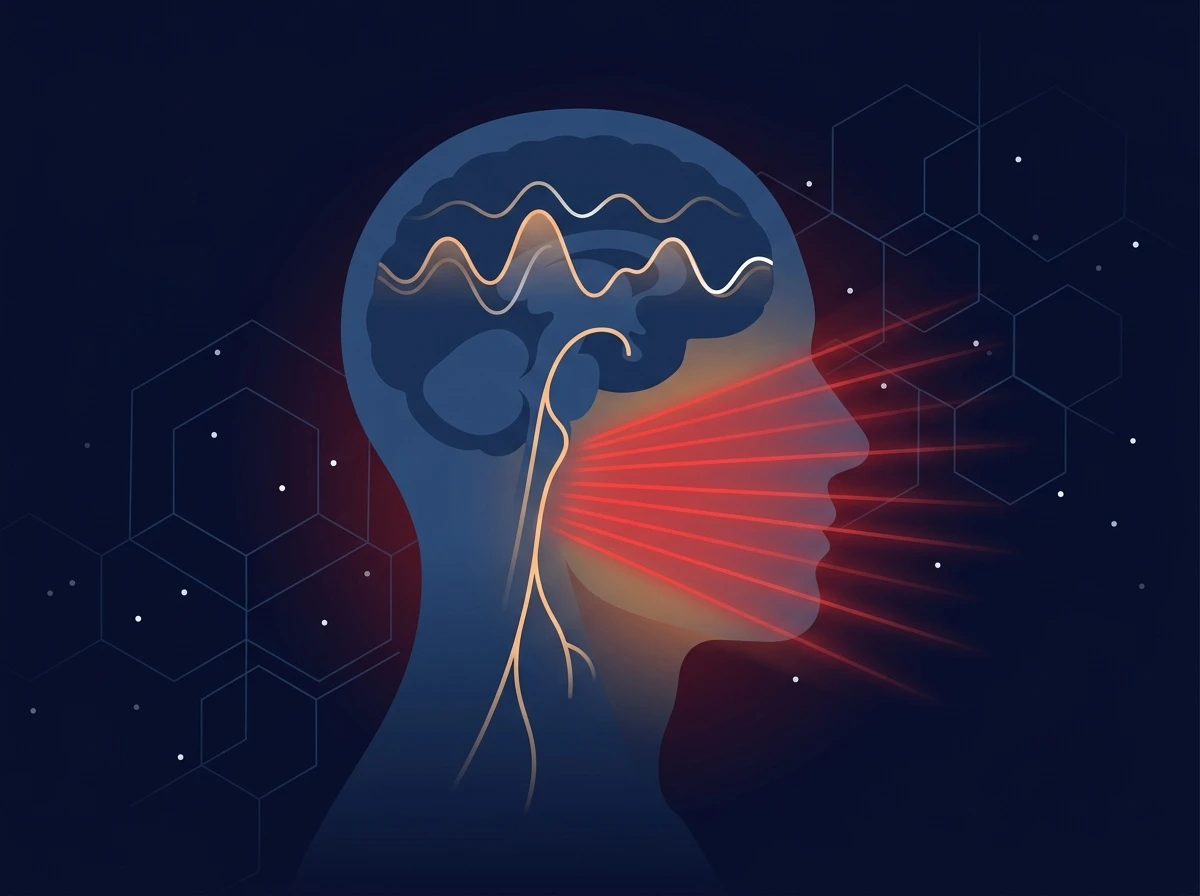
Red light at wavelengths around 660–680 nm (and near-infrared 800–850 nm) is absorbed by mitochondrial cytochrome c oxidase, increasing ATP production and modulating reactive oxygen species. Animal and emerging human studies suggest two anxiety-relevant downstream effects:
- Reduced neuroinflammation — chronic low-grade brain inflammation correlates with elevated anxiety scores
- Modulation of cortical excitability — particularly in the prefrontal cortex, an area implicated in anxiety regulation
Study 1 — Schiffer et al. (2009): Major Depression and Anxiety
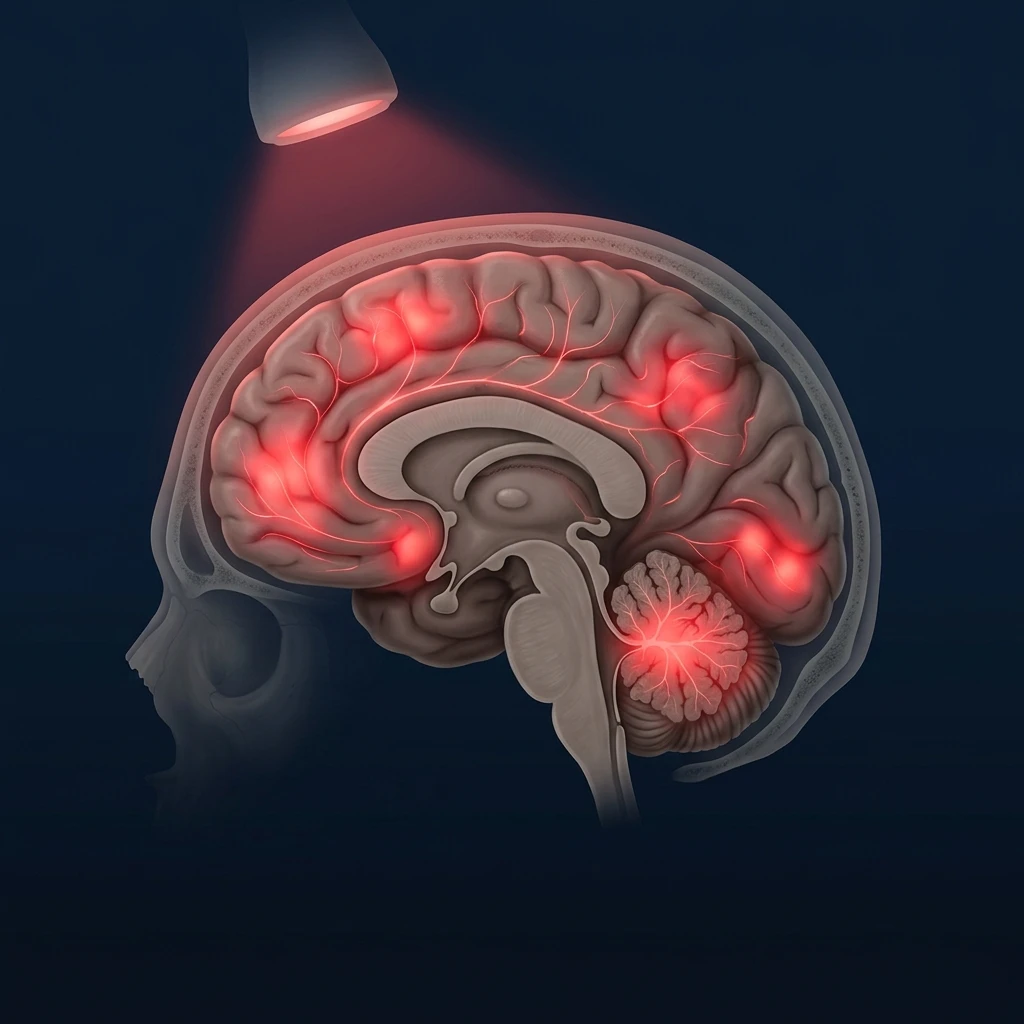
Citation: Schiffer, F., Johnston, A. L., Ravichandran, C., et al. (2009). Psychological benefits 2 and 4 weeks after a single treatment with near infrared light to the forehead. Behavioral and Brain Functions, 5(1), 46.
Open trial in 10 patients with major depression, 7 of whom also met criteria for anxiety. Participants received a single ~4-minute session of 810 nm NIR light to the forehead. At 2 weeks, 6 of the 7 anxious patients showed significant decreases in HAM-A (Hamilton Anxiety) scores. At 4 weeks, effects persisted in most. Limitation: Open-label, no control group, small sample.
Study 2 — Cassano et al. (2018): Transcranial Photobiomodulation for MDD
Citation: Cassano, P., Petrie, S. R., Mischoulon, D., et al. (2018). Transcranial photobiomodulation for the treatment of major depressive disorder. Journal of Affective Disorders, 235.
Double-blind randomized sham-controlled trial in 21 patients. Active group received 830 nm NIR light to the forehead twice weekly for 8 weeks. The active group showed significantly greater reductions in depression scores; secondary analyses showed parallel improvements in anxiety subscales. Strength: Sham-controlled. Limitation: Small N, NIR not red light specifically.
Study 3 — Caldieraro & Cassano (2019): Brain Photobiomodulation Review
Citation: Caldieraro, M. A., Cassano, P. (2019). Transcranial and systemic photobiomodulation for major depressive disorder: A systematic review of efficacy, tolerability and biological mechanisms. Journal of Affective Disorders, 243.
Systematic review of 9 trials. Across studies using wavelengths in the 630–1064 nm range, anxiety symptoms — when measured as a secondary outcome — showed consistent reductions, with effect sizes comparable to first-line antidepressant medications in some cohorts. Caveat: Heterogeneous protocols, small total N (~150 across all studies).
Study 4 — Maksimovich (2020): Red Light & Stress Markers
Citation: Maksimovich, I. V. (2020). The use of red light for influence on the human body in stress conditions. Open Journal of Stress, Anxiety and Depression.
Observational study examining cortisol and self-rated stress in 36 adults over 30 days of red-light therapy (660 nm, 20-minute sessions). Showed statistically significant reductions in salivary cortisol at day 30 and improvement in subjective Perceived Stress Scale scores. Limitation: Non-blinded, observational design.
Study 5 — Salehpour et al. (2018): Mechanism Review on Brain PBM
Citation: Salehpour, F., Mahmoudi, J., Kamari, F., et al. (2018). Brain photobiomodulation therapy: a narrative review. Molecular Neurobiology, 55(8).
Comprehensive mechanistic review covering anxiety-relevant pathways. Identifies four documented mechanisms by which red and NIR light may reduce anxiety symptoms:
- Increased ATP and reduced oxidative stress in prefrontal cortex neurons
- Up-regulation of brain-derived neurotrophic factor (BDNF)
- Modulation of inflammatory cytokines
- Increased cerebral blood flow in anxiety-relevant regions
Honest Summary of the Evidence
The body of evidence is promising but preliminary. Most studies are:
- Small (N often < 30)
- Open-label or weakly controlled
- Use NIR (810–830 nm) more often than visible red (660–670 nm)
- Targeted at depression, with anxiety measured as a secondary outcome
What we can say: there is consistent direction-of-effect across multiple independent studies, supported by plausible biological mechanisms. What we cannot say: that red light therapy is a clinical-grade treatment for anxiety disorders. It is not a substitute for therapy, medication, or a healthcare provider's evaluation if you suffer from a diagnosed anxiety disorder.
How to Try Red Light for Anxiety Support
- Use 670 nm red light (or 810 nm NIR if available)
- 10–20 minute sessions, 5–7 days per week
- Position the light 30–60 cm from face/upper torso
- Evaluate after 4 weeks of consistent use
- Consider combining with proven anti-anxiety practices: regular exercise, breath-work, sleep hygiene, therapy if needed
How CalmiPulse Fits In
CalmiPulse Core delivers calibrated 670 nm red light alongside 7.83 Hz Schumann frequency emission — the latter targeting the parasympathetic nervous system, which is functionally important in anxiety regulation. The combined approach reflects current best understanding of anxiety as a multi-system phenomenon. View CalmiPulse Core specifications →
If you have a diagnosed anxiety disorder, talk to your healthcare provider before adding any new wellness device to your routine.
References
- Schiffer, F., et al. (2009). Behavioral and Brain Functions, 5(1).
- Cassano, P., et al. (2018). Journal of Affective Disorders, 235.
- Caldieraro, M. A., Cassano, P. (2019). Journal of Affective Disorders, 243.
- Maksimovich, I. V. (2020). Open Journal of Stress, Anxiety and Depression.
- Salehpour, F., et al. (2018). Molecular Neurobiology, 55(8).
- National Institute of Mental Health (NIMH). (2023). Anxiety Disorders Statistics.
CalmiPulse — evidence over hype.
Explore more: For a practical look at how these technologies are integrated into daily wellness routines, see our latest comparison of the best red light sleep devices 2026.