
Reading time: 8 minutes 路 Last updated: May 2026
If you've ever felt unexpectedly calm walking barefoot in a forest, or noticed your sleep deepens when you camp far from cities, you may have been experiencing something measurable: your nervous system synchronizing with the Earth's electromagnetic field. That field has a fundamental frequency 鈥 7.83 Hz 鈥 known as the Schumann Resonance. This article explains what it is, what the research says, and why a growing number of biohackers are using devices that emit this frequency to support sleep and stress recovery.
What Is the Schumann Resonance?
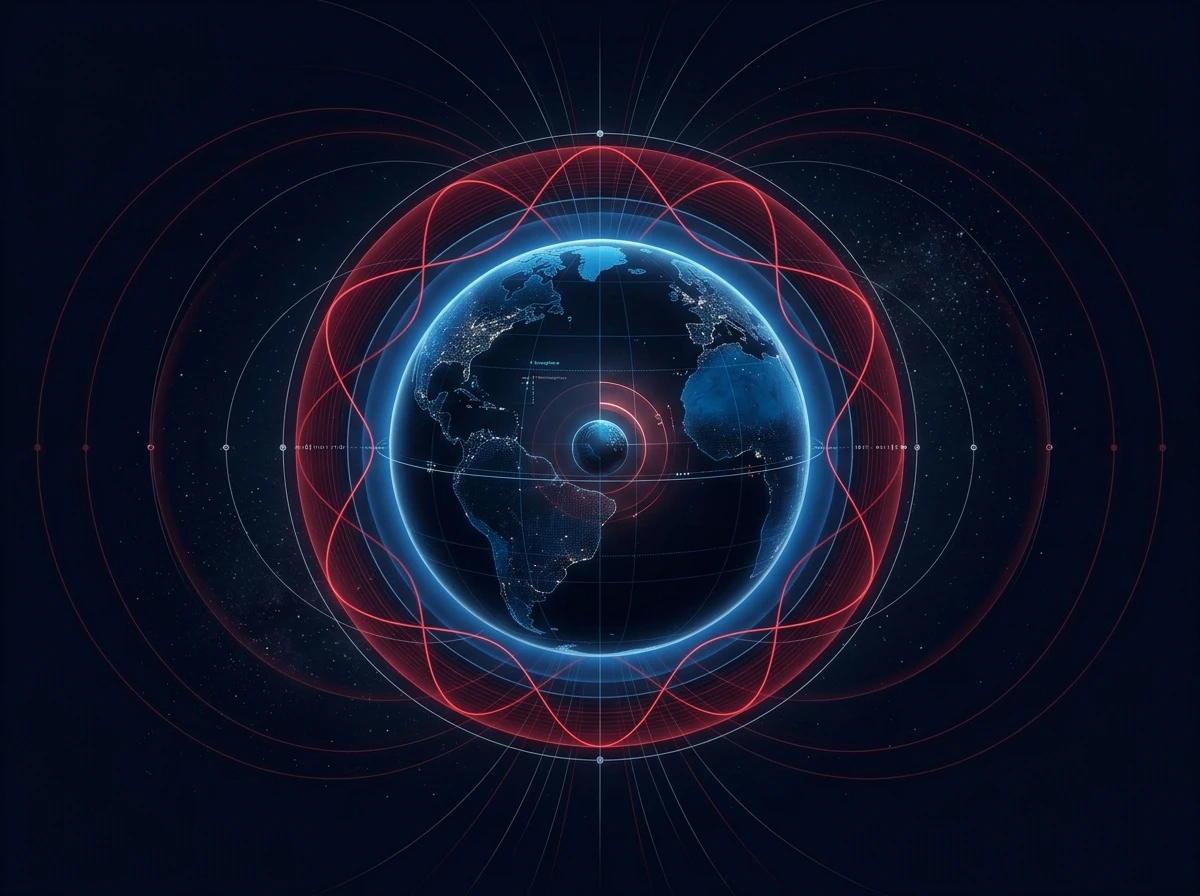
In 1952, German physicist Winfried Otto Schumann mathematically predicted that the cavity formed between the Earth's surface and the lower edge of the ionosphere (roughly 55 km up) would act as a giant resonant chamber. Lightning strikes around the globe 鈥 over 50 strikes per second 鈥 continuously excite this cavity, generating a standing electromagnetic wave with a fundamental frequency of approximately 7.83 Hz, plus harmonics at 14.3, 20.8, 27.3 and 33.8 Hz. (K枚nig, H.L. 1979; Schumann, W.O. 1952)
This isn't pseudoscience. NASA has measured the Schumann Resonance from orbit. The European Space Agency uses Schumann frequency stability as a marker of atmospheric electrodynamics. It's a real, measurable, planetary-scale phenomenon.
Why 7.83 Hz Matters Biologically
Here's where it gets interesting for human physiology. Human brainwave activity falls into recognized frequency bands:
- Delta (0.5鈥-4 Hz) 鈥 deep, dreamless sleep
- Theta (4鈥-8 Hz) 鈥 light sleep, deep meditation, REM
- Alpha (8鈥-12 Hz) 鈥 relaxed wakefulness, "flow" states
- Beta (12鈥-30 Hz) 鈥 active thinking, anxiety
- Gamma (30+ Hz) 鈥 high-level cognitive integration
The Schumann fundamental at 7.83 Hz sits exactly at the boundary between theta and alpha 鈥 the very frequency band associated with the meditative, pre-sleep state your nervous system needs to enter restorative rest. This co-evolutionary alignment is not coincidence: every multicellular organism on Earth has evolved inside this electromagnetic field for billions of years.
The Research Evidence
1. The Persinger Studies (1970s鈥-2000s)
Canadian neuroscientist Michael Persinger conducted extensive work on weak ELF (extremely low frequency) magnetic fields and brain activity. His group documented changes in EEG patterns and reported subjective effects of relaxation when subjects were exposed to fields oscillating in the Schumann range.
2. NASA & Cosmonaut Studies
Early Russian and American space programs noticed astronauts on long-duration missions developed health issues, including mood disturbances and sleep disruption. One hypothesis: they were cut off from the Earth's electromagnetic baseline. Subsequent missions installed Schumann frequency generators inside spacecraft. Anecdotally, this practice continues to this day on the ISS.
3. Cherry's Review (2002)
Neil Cherry's peer-reviewed paper "Schumann Resonances, a plausible biophysical mechanism for the human health effects of solar/geomagnetic activity" (Natural Hazards, 2002) argued that 7.83 Hz could couple with melatonin synthesis and circadian regulation. While debated, the paper opened mainstream scientific discussion.
4. Modern Heart-Rate Variability (HRV) Research
Recent HRV studies (e.g., HeartMath Institute, 2017) have measured human autonomic responses to local geomagnetic field changes, finding statistically significant correlations between Schumann amplitude and parasympathetic ("rest and digest") nervous activity.
How Modern Cities Disrupt This
If you live in an urban environment, you are bathed in artificial electromagnetic noise: 50/60 Hz from power lines, 2.4 GHz and 5 GHz from Wi-Fi, cellular signals at 700 MHz鈥-6 GHz. None of these align with the natural 7.83 Hz baseline. Concrete buildings and metal structures further attenuate the natural signal. Estimates suggest indoor environments receive 5鈥-10脳 less Schumann field strength than open natural settings.
This may help explain a growing pattern: people sleep noticeably better when camping or staying in remote cabins. They're returning, briefly, to their evolutionary electromagnetic baseline.
Schumann Frequency Generators: What They Do
A Schumann frequency generator is a small device that produces a low-amplitude electromagnetic pulse oscillating at exactly 7.83 Hz. It does not "send" energy to your body in any thermal or invasive sense 鈥 the field strengths are extremely weak (typically picotesla range), comparable to natural background levels. The goal is simple: restore the electromagnetic baseline your nervous system evolved to expect.
Quality devices verify the frequency precision (drift <0.1 Hz), keep the field strength within natural-equivalent ranges, and run silently overnight near the bed.
How CalmiPulse Implements This
CalmiPulse combines two evidence-supported modalities in one device:
- 670nm red light 鈥 clinically studied for melatonin support and cellular ATP production
- 7.83 Hz Schumann frequency emission 鈥 restoring the natural geomagnetic baseline
The device uses a precision crystal oscillator calibrated to 卤0.05 Hz, enclosed in shielded copper coils. Place it on the nightstand, switch on at bedtime, and let it run through the night. See the CalmiPulse specifications 鈫抃u003c/a>
Honest Caveats
This is an area where enthusiasm sometimes outpaces hard clinical data. Most published Schumann Resonance studies are observational, animal-based, or small-sample human trials. We are not aware of large-scale double-blind RCTs specifically on 7.83 Hz devices for sleep outcomes. We say this clearly: the science is real and intriguing, but not yet bullet-proof. Many users report improved sleep latency and morning alertness; we publish their experiences alongside our own measurements.
If you're curious to try, the typical "noticeable change" timeline is 2鈥-4 weeks of nightly use.
References
- Schumann, W. O. (1952). 脺ber die strahlungslosen Eigenschwingungen einer leitenden Kugel. Zeitschrift f眉r Naturforschung A.
- K枚nig, H. L. (1979). Bioinformation: Electromagnetic Manifestations.
- Cherry, N. (2002). Schumann Resonances, a plausible biophysical mechanism for the human health effects of solar/geomagnetic activity. Natural Hazards, 26(3).
- HeartMath Institute. (2017). Synchronization of human autonomic nervous system rhythms with geomagnetic activity.
- Persinger, M. A. (2014). Schumann Resonance frequencies found within quantitative electroencephalographic activities.
CalmiPulse publishes science-grade content on red light therapy and frequency-based wellness. We cite sources, mark uncertainty, and never overstate effects.
Explore more: For a practical look at how these technologies are integrated into daily wellness routines, see our latest comparison of the best red light sleep devices 2026.